History
The IQB’s work is based on the educational standards adopted by the KMK. Following the introduction of these competence goals for the general school system, the IQB’s initial focus was on translating them into measurable test items. The IQB developed, piloted, and standardised task pools for German and Mathematics at primary level, and for German, Mathematics, first foreign languages (English and French), and the sciences (Biology, Chemistry, and Physics) at lower secondary level. On this basis, proficiency level models were developed.
IQB Trends in Student Achievement
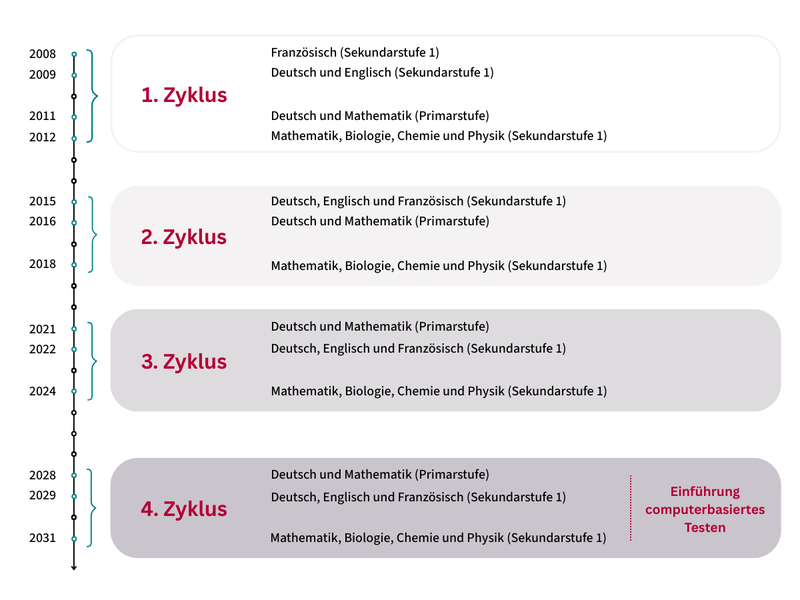
Since 2008, the IQB has regularly assessed the extent to which the educational standards are being met through studies that were initially referred to as “IQB National Assessment Studies” and, since 2016, as “IQB Trends in Student Achievement.”
IQB Trends in Student Achievement: National educational monitoring based on the KMK educational standards:
Nationwide Achievement Tests (VERA)
As early as 2006, the KMK series of measures for quality improvement and monitoring in education included plans to introduce Nationwide Achievement Tests (VERA) in primary education. This measure was later extended to lower secondary education. Each year, the IQB coordinates the development and piloting of test items for German and Mathematics at primary level, and for German, Mathematics, and the first foreign languages (English and French) at lower secondary level, and makes them available to the federal states for the mandatory achievement tests carried out in schools. Since 2010, South Tyrol and the German-speaking Community of Belgium have been participating in VERA.
Since 2013, the IQB has coordinated the development and ongoing refinement of educational standards for the General Higher Education Entrance Qualification, as well as a Joint Pools of Abitur Exam Tasks for German, English, French, and Mathematics. In 2017, the federal states were able to use these joint Abitur exam tasks for the first time. From the 2025 examination year onwards, a joint pool of examination questions for Abitur exams is also available for the science subjects Biology, Chemistry, and Physics.
On June 18, 2020, the KMK decided to refine the educational standards for primary and lower secondary education. The aim was to reflect the KMK strategy “Education in the Digital Age” and to acknowledge further changes in subject-specific didactics and in young people’s everyday lives. The IQB coordinated this process.
Development and Refinement of the Educational Standards:

Furthermore, the KMK decided to transition the IQB’s assessment procedures to digital formats. To support this transition, the IQB has been developing a web-based testing system since 2018. Since 2022, digital test items have been developed in line with the refined educational standards. This gradual process began with German and Mathematics at primary level, and is set to conclude in 2030 with Mathematics, Biology, Chemistry, and Physics at lower secondary level.
Timeline:
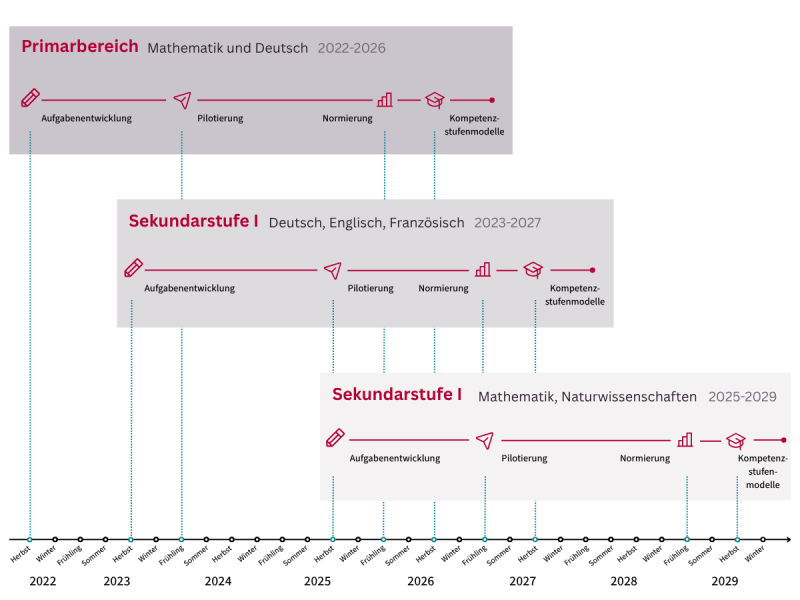
Starting with the fourth cycle, the IQB Trends in Student Achievement will be conducted digitally. Likewise, the VERA tests are set to transition to digital formats in 2027. This transition enables adaptive and formative testing. Since 2023, this expansion of functionality has been supported through project funding (TBA II) under the DigitalPakt initiative.
In 2024, the KMK expanded the IQB key focus to include the transition from early childhood education to primary school. To this end, the IQB is running the collaborative project “StarS – Starting Strong in Primary School”, which aims to strengthen support for the development of basic competences that are essential for meeting the KMK minimum standards. Alongside the collaborative partners Prof. Dr Hedwig Gasteiger (Osnabrück University) and Prof. Dr Michael Krelle (Chemnitz University of Technology), StarS develops and pilots methods for evaluating children’s proficiency levels at the start of Grade 1 and their learning progress until the beginning of Grade 2. Furthermore, StarS develops professional development modules for teachers to support them in using the test results to provide targeted support for students. StarS builds on existing joint initiatives of the federal states for quality development and quality assurance (in particular, the assessments of basic competences in TBA II, VERA, and the IQB Trends in Student Achievement), thereby helping to further strengthen the coherence between assessment and targeted support.
For more than 20 years, Germany has participated in international and national large-scale assessments of student achievement (e.g., PISA, IGLU, IQB Trends in Student Achievement). This has created a substantial data set that can be used to address a wide range of research questions. To make this potential available for further research, the Research Data Centre (FDZ) at the IQB was established in 2007 to provide data for reanalysis and secondary analysis. Since 2011, the FDZ at the IQB has been part of the Centre for International Student Assessment (ZIB) and, following positive evaluations, was established on a permanent basis in 2023.
Copyright Grafiken: IQB e. V., Lizenz: Creative Commons (CC BY). Volltext unter: https://creativecommons.org/licenses/by/4.0/legalcode.de