Test development
To assess whether educational standards are being achieved, the Nationwide Achievement Tests (VERA) and the IQB Trends in Student Achievement need test items based on subject-specific didactics and empirical research.At the IQB. interdisciplinary teams of teachers with experience in task development, leading scholars in the respective subject didactics and experts in empirical educational science collaborate to develop these test items.
How are the test items developed? 🔗
The development of test items comprises four stages:
- Teachers involved in the item development process share their initial ideas and item drafts.
- Together with experts in subject didactics, teachers from various German states discuss and, if necessary, revise the item drafts during developers’ meetings held several times a year.
- To assess whether the test items are comprehensible for students, they are pre-tested in individual school classes (pre-pilot phase) and revised again if necessary.
- Within a larger pilot study, the items are tested with randomly selected school classes from several states. Based on the collected data, researchers determine test item difficulty and other statistical indicators to guide final revisions and choose items for the final test item pool.
Overall, the development of test items – from initial drafts to final versions – takes about two to three years.

How is the test system modernised? 🔗
In 2018, the IQB began a comprehensive modernisation of its assessment system. This modernisation process includes both item development aligned with revised educational standards as well as digital testing.
For each subject, test items are initially developed according to the steps outlined above. The aim of the new item pools is to cover the full range of competences described in the revised educational standards, insofar as these can be assessed within the framework of large-scale assessments.Alongside established item formats, such as multiple-choice questions, which are common in paper-based assessments, there are also new and innovative items that require students to use digital tools (e.g., GeoGebra in Mathematics) or are presented with information in video format.These new item formats in particular, as well as the digital assessment environment as a whole, require comprehensive testing in terms of usability and technical implementation.
The item pool, finalised on the basis of the pilot study results, is then administered in large-scale standardisation studies to a sample of students that is representative of Germany as a whole.The standardisation studies are the empirical basis for the development of new proficiency level models across different subjects and proficiency domains.The digital test items and the new proficiency level models will be used in future IQB Trends in Student Achievement and Nationwide Achievement Tests (VERA) to determine the extent to which the revised educational standards are being met.The new test items and proficiency level models will be incorporated into educational monitoring from 2027.
The process of modernisation consists of three consecutive phases that partly overlap in time, as illustrated in the timeline below.
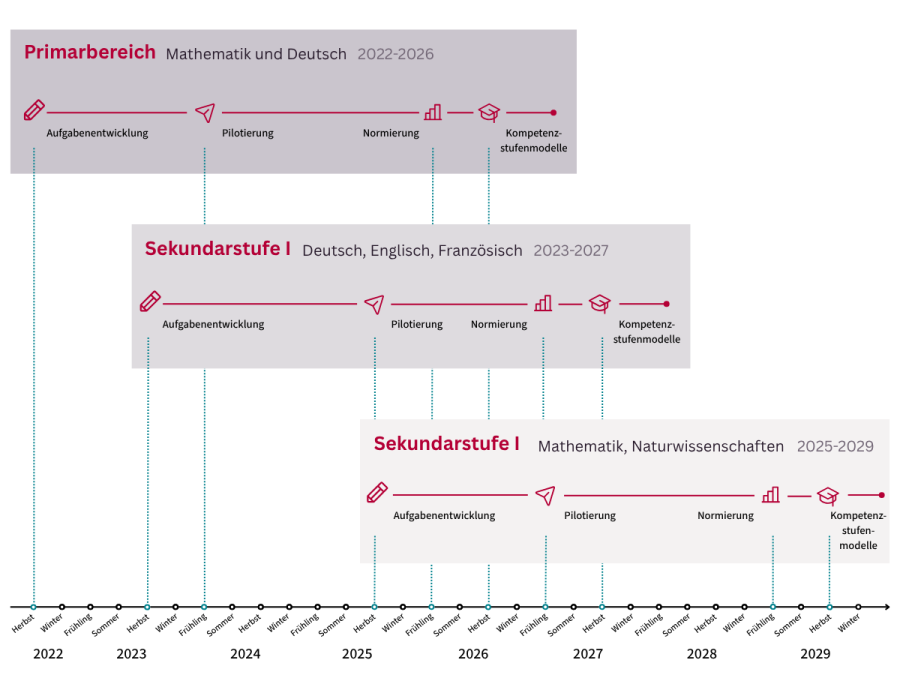
Image sources listed in order of appearance on the page, from left to right and top to bottom; attribution in accordance with the guidelines of the copyright holders/image databases.
- Copyright 2025 Katerina Limpitsouni
- Copyright Grafiken: IQB e. V., Lizenz: Creative Commons (CC BY). Volltext unter: https://creativecommons.org/licenses/by/4.0/legalcode.de